Vb.net Send File Over Network
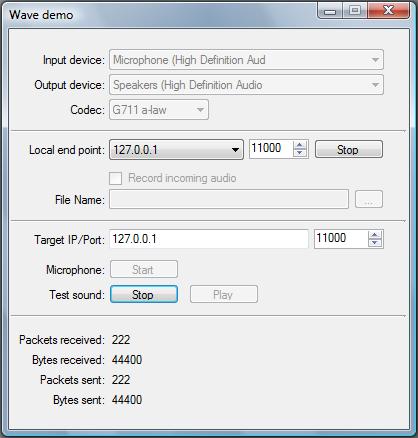
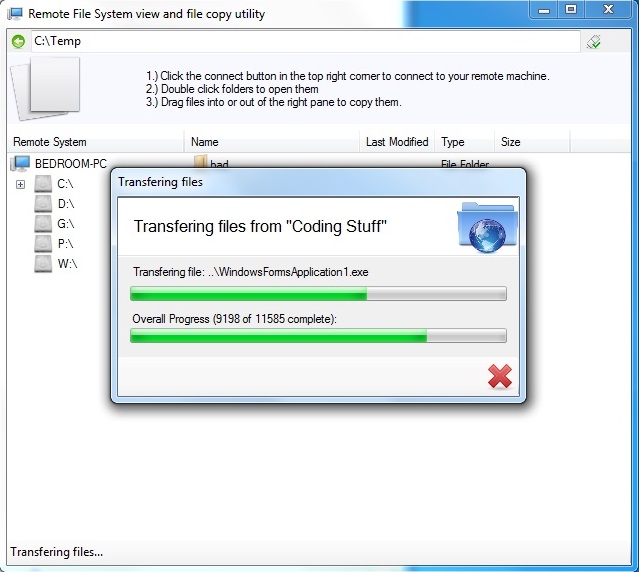
Good Evening!So, just at home, thinking about work and we have a common problem that requires a certain file to be copied over to a remote computer. So I'm making a really basic program to simplify the task for us.The idea of it is, we keep the file on the root of C: and it copies it to a remote computer to a specific directory. After doing a little research, here is the simple code I ended up with.Dim strCompName As String = 'strCompName = TextBox1.TextMy.Computer.FileSystem.CopyFile('C:file.dll', ' & strCompName & 'C$Program Filesotherlocation')End SubEnd Class.
This code (the first of its kind in the VB.NET section of PSC) will allow you to quickly and easily send a file over dialup, LAN or BroadBand.
Some basic troubleshooting steps:1. Make sure the FileSystemWatcher's EnableRaisingEvents property is set to true.2. Make sure you have not set the FileSystemWatcher's Filter to ignore the type of files being dropped into the folder.3. Make sure you have set the FileSystemWatcher's NotifyFilter to include to watch for Created files.-MikeMike McIntyre MVP'Goran Djuranovic'. Hi Mike,Thanks for your response. Yes, all of those are set correctly.Using this works fine:With Me.FolderWatcherObj.NotifyFilter = (NotifyFilters.FileName Or NotifyFilters.LastWrite Or NotifyFilters.LastAccess Or NotifyFilters.CreationTime Or NotifyFilters.Size).Path = 'C:MyFolder'.Filter = '.txt'.IncludeSubdirectories = False.InternalBufferSize =.InternalBufferSize + 81920.EnableRaisingEvents = TrueEnd WithUsing this doesn't work:With Me.FolderWatcherObj.NotifyFilter = (NotifyFilters.FileName Or NotifyFilters.LastWrite Or NotifyFilters.LastAccess Or NotifyFilters.CreationTime Or NotifyFilters.Size).Path = MyServerMyFolder. Hi Goran,I'm sorry that the documentation of FileSystemWatcher.InternalBufferSizedidn't state very clear about the buffer size when monitoring network path.It's recommended not exceeds 64K when monitoring network path.FileSystemWatcher is basically a.Net wrapper for the Win32ReadDirectoryChangesW API.
To use ReadDirectoryChangesW, you create andspecify a buffer that the OS will populate with the changes. However, whatis not mentioned in the ReadDirectoryChangesW documentation (but is hintedin the FileSystemWatcher docs) is that the file system creates an internalkernel buffer to store the change information temporarily until it has thechance to update the user buffer. The size of the kernel buffer that iscreated is the same size that is specified in ReadDirectoryChangesW and iscreated in non-paged pooled memory. Every time a FileSystemWatcher /ReadDirectoryChangesW is created / called, a new kernel buffer is alsocreated.The kernel memory pools (paged and non-paged) are set aside in the systemaddress space for device drivers and other kernel components to use. Theygrow and shrink dynamically as necessary. The current size of the poolscan be easily seen by going to the Performance tab of the Task Manager.The pools will grow dynamically until they hit a maximum value which iscalculated at boot time and depends on available system resources (mostlyRAM).
You do not want to hit this maximum value or else various systemservices and drivers will start failing. However, this calculated maximumvalue is not easily available. To determine the maximum pool sizes, youneed to use a kernel debugger. If you are interested in furtherinformation about the system memory pools, I recommend that you look atChapter 7 in the MSPress book Inside Windows 2000 by Solomon andRussinovich.With this in mind, there is no recommendation on what size buffers you canuse. The current and maximum size of the system pools are going to bevaried from client to client. However, you probably should not go over 64kfor each FileSystemWatcher / ReadDirectoryChangesW buffer.
This stems fromthe fact that there is a 64k limitation with network access as documentedin ReadDirectoryChangesW. But in the end you are going to have to test theapplication on a variety of expected target systems so that you can tuneyour buffer.There is overhead associated with.Net applications and I imagine that aWin32 ReadDirectoryChangesW program might be able to achieve betterperformance with the same buffer size. However, with very fast andnumerous file changes, buffer overruns will be inevitable and the developeris going to have to handle the case when an overrun occurs such as manuallyenumerating the directory to detect the changes.In conclusion, FileSystemWatcher and ReadDirectoryChangesW are alightweight file change detection mechanism that is going to have itslimitations. Change Journals is another mechanism which we would considera medium-weight solution, but would still have limitations:Heavy-weight solutions would be to write a dedicated file system filterdriver that sits in the file system stack and monitors file system changes.Of course this would be the most complex approach. Most virus scanners,backup software, and file system monitoring utilities such as filemon implement a filter driver.I hope above explanation helps you to understand the root cause of theissue you're experiencing. Please reply to let us know whether or not youneed further information.
Thank you.Sincerely,Walter Wang (wa.@online.microsoft.com, remove 'online.' )Microsoft Online Community SupportGet notification to my posts through email? Please refer toications. If you are using Outlook Express, please make sure you clear thecheck box 'Tools/Options/Read: Get 300 headers at a time' to see your replypromptly.Note: The MSDN Managed Newsgroup support offering is for non-urgent issueswhere an initial response from the community or a Microsoft SupportEngineer within 1 business day is acceptable. Please note that each followup response may take approximately 2 business days as the supportprofessional working with you may need further investigation to reach themost efficient resolution. The offering is not appropriate for situationsthat require urgent, real-time or phone-based interactions or complexproject analysis and dump analysis issues. Issues of this nature are besthandled working with a dedicated Microsoft Support Engineer by contactingMicrosoft Customer Support Services (CSS) at.This posting is provided 'AS IS' with no warranties, and confers no rights.

Vb.net Send File Over Network Free
What Server OS is the target filesystem on? As far as I know, only Win95,98, ME, XP, 2000, and 2003 support the FSW interface. NT 4 and earlier andno version of Samba that I'm aware of support FSW.Mike Ober.' Goran Djuranovic'. Walter,You were right on the target.
Vasco da gama keygen. Vasco da GamaVasco StreetMapsLearning courseCreate professionally animated travel routesConfigure your travel route animation according to your individual criteria and make the most of numerous and versatile effects!Vasco StreetMaps - simply beautiful mapsThe top of individual map design.
Nothing else was wrong, but theInternalBufferSize. When I decreased it to 50K (51200B) worked like a charm.It would not work above that size for that specific network connection.Thanks a lot everyoneGoran Djuranovic'Walter Wang MSFT'.
Comments are closed.